
For a smallholder farmer, getting paid promptly after delivering a crop can make a huge difference. But for the cooperative buying from hundreds or thousands of farmers, those payments can require millions of dollars in working capital, often before the cooperative itself has been paid by its buyers.
That is one of the gaps Root Capital helps fill.
Root Capital works with agricultural businesses and cooperatives that connect smallholder farmers to markets. It provides financing tailored to agricultural enterprises, alongside training and other support.
But providing capital is only part of the equation.
For cooperatives to succeed over the long term, farmers need to continue producing good crops and selling through those cooperatives. That means farmers also need practical agricultural knowledge, from when to prune or apply compost to how to protect soil moisture and improve harvest quality.
And consistently reaching thousands of farmers regularly, many of them in remote rural communities, is hard.
Taking agricultural training beyond the classroom
As part of its Digital Extension Advisory Service (DEAS), Root Capital uses engageSPARK to communicate directly with smallholder farmers through SMS and automated voice calls (IVR).
The messages cover practical topics throughout the crop cycle, including planting, composting, pruning, pest and disease management, soil and water conservation, harvesting, and post-harvest handling.
To make these messages useful and relevant, local agronomists working with participating cooperatives and agricultural enterprises develop these messages, and that’s how they fit the local context, based on the crop, local farming practices, language, and stage of the crop calendar. Root Capital advisors support that process.
The goal is not to replace in-person training but to complement it so that the lessons are reinforced over time—and reach people who could not attend the in-person sessions.
To do the reinforcing effectively, Farmers receive SMS messages weekly throughout the year. Using engageSPARK’s SMS drip campaign, Root Capital can schedule a series of messages in advance and have them sent automatically over time.
The sequence follows the crop calendar, so what farmers receive each week matches what they should be doing on their farms at that stage of production.
It also matters that both SMS and IVR work on basic keypad phones. Farmers do not need a smartphone, mobile app, or internet connection to receive a text message or answer an automated voice survey. That makes these channels especially useful for reaching farmers in rural areas where smartphones and mobile data may be less common.
“When I receive a message, I go to my coffee field”
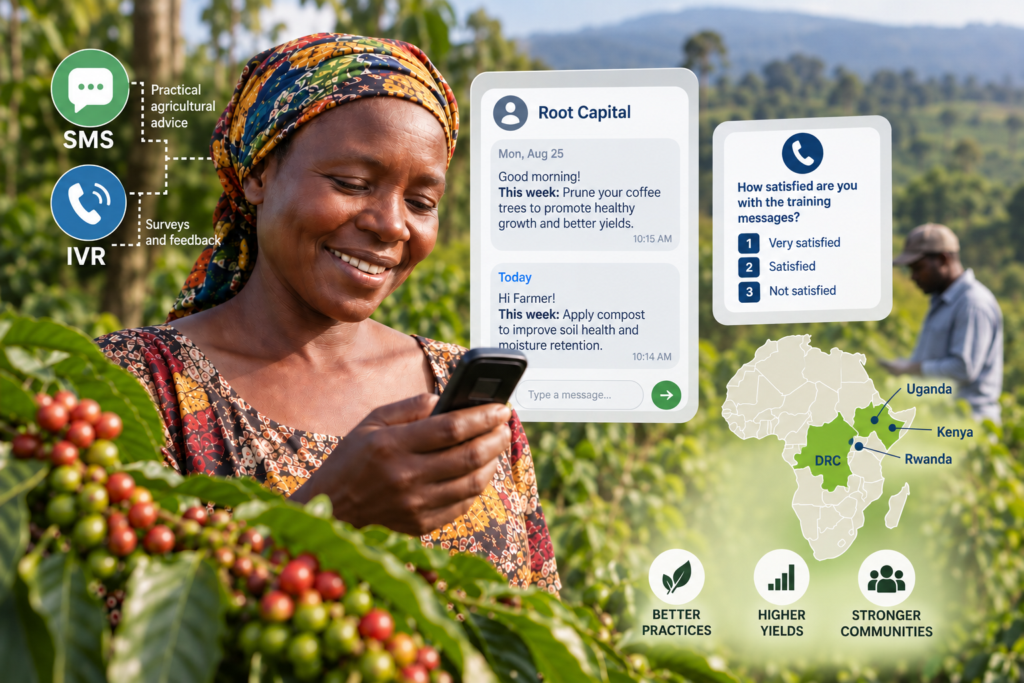
For farmers receiving the messages, those reminders improve how they tend to their crops.
For example, Nyiramugisha Bernadette, a coffee farmer in Rwanda, told a Root Capital advisor that when a weekly message arrives, she reads it and then goes to her coffee field to see whether she has carried out the recommended activity.
If something hasn’t been done, she acts on it.
She specifically pointed to practices such as organic fertilization, pruning, erosion control, and mulching, and reported that these practices have helped increase her production and improve her farming skills.
For Sakwa Millon, a coffee farmer in Uganda, the benefit is also about convenience.
As a school teacher, he cannot regularly attend group agricultural trainings. The digital messages allow him to receive information about good coffee farming practices directly on his phone and apply what he learns on his farm.
That is one of the big advantages of mobile messaging. An agronomist can only be in one place at a time, but SMS can keep reinforcing their training across thousands of farms.
Reaching thousands of farmers
In its previous campaign cycle, ending in July 2026, Root Capital reached approximately 2,800 farmers in Rwanda and 2,700 in Uganda through engageSPARK. It is currently reaching approximately 2,700 farmers in the Democratic Republic of Congo.
Root Capital has found SMS especially useful for educational messages. Even if a farmer’s phone is switched off when a message is sent, it can be delivered when the phone reconnects, and the farmer can return to the message later.
For surveys, Root Capital has found automated voice calls (IVR) more effective at getting farmers to respond. Farmers answer questions by pressing keys on their phone, which can also make participation easier for people with limited literacy.
And again, farmers do not need smartphones. A basic keypad phone is enough to receive the call and respond.
What happened when Root Capital asked farmers for feedback?
In 2024, Root Capital used engageSPARK to run automated IVR satisfaction surveys with farmers in Rwanda, Uganda, and Kenya.
The results:
| Country | Farmers enrolled to IVR survey | Total picked up | Total answered Q1 of survey | Completed survey |
| Rwanda | 2,006 | 1,595 (79.5%) | 706 | 513 |
| Uganda | 2,012 | 1,911 (95.0%) | 632 | 448 |
| Kenya | 6,030 | 4,735 (78.5%) | 1,165 | 555 |
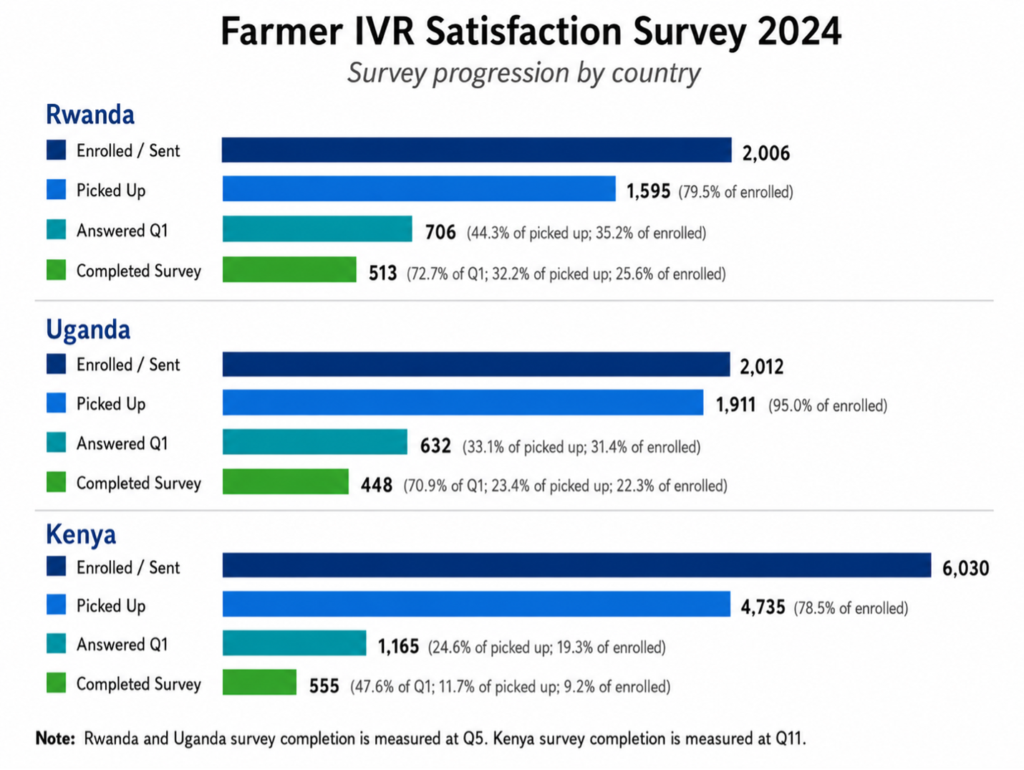
Among farmers who answered the first question, 72.7% in Rwanda and 70.9% in Uganda completed the entire five-question survey.
Kenya’s survey was longer, with 11 questions. Even there, 555 farmers completed the full survey, representing 47.6% of those who started it.
So with engageSPARK’s platform, Root Capital can use the same system to send agricultural information to farmers via SMS and then hear directly from those farmers and collect feedback through IVR about what is working.
It hasn’t worked perfectly everywhere
Mobile messaging has helped Root Capital reach farmers at scale, but the experience has not been without challenges.
While in Kenya, a small number of farmers have chosen to opt out of the service, other challenges stem from the channels themselves.
In the Democratic Republic of Congo, Root Capital has seen lower SMS delivery rates there, which may be related to mobile connectivity, network coverage, or the quality of farmers’ phone numbers.
IVR comes with its own challenges. Some farmers answer an automated call and respond as if they are speaking to a real person, rather than following the instructions and pressing a number on the keypad. That can affect whether they successfully complete the survey.
One option for addressing this is speech recognition. engageSPARK’s IVR surveys can accept spoken answers as well as keypad responses, so instead of hearing “Press 1 for yes or 2 for no,” a farmer can simply be asked to say “yes” or “no.” The platform interprets the spoken response and can use it in the survey flow just like a keypress response.
For farmers who naturally try to speak back to an automated call, this could make the interaction feel more intuitive and may be worth testing alongside traditional keypress questions.
Network coverage, familiarity with automated calls, literacy, language, and the way farmers use their phones can all affect the results. That is why Root Capital continues to look at delivery and survey data and adjust how it communicates with different groups.
Reaching farmers who can’t always attend training
Farmers may live far from a training location, have work or family commitments, or simply be unable to attend every session.
SMS and IVR help make sure those farmers can still receive regular agricultural information and reminders. Root Capital does not see mobile messaging as a replacement for people.
Its experience has been that it works best alongside agronomists and face-to-face training. In-person sessions provide the knowledge and interaction, while SMS and IVR reinforce that knowledge afterward and remind farmers to apply it.
Why Root Capital chose engageSPARK
For Root Capital, choosing a technology partner was not simply about finding a platform capable of sending thousands of messages. It’s also about having a partner who appreciates the situation on the ground.
As Washington Ndwiga, ACRA Coordinator at Root Capital, explains:
“engageSPARK was (and I believe still is) among the most tested and reliable platforms for our context. They seemed to understand the uniqueness of the communities we serve in matters of diverse cultures, languages, remoteness, and the technological challenges facing our farming communities.”
He adds:
“We found them willing to fit in our context rather than us trying to conform to their space.”
And ultimately:
“We shared a common mission, i.e. creating impact in remote rural communities by connecting and creating impact among the hard-to-reach or offline populations at scale.”
Start with the farmer
One of Root Capital’s biggest lessons is that you shouldn’t start by deciding whether to use SMS or IVR. You start with the farmer: What crop are they growing? What should they be doing this week? What language do they speak? What information will actually be useful when they walk onto their farm tomorrow?
Root Capital recommends working closely with local agronomists, keeping messages simple and practical, matching them to the crop calendar, and choosing SMS or IVR based on what works best for the farmers.
As Root Capital puts it:
“Overall, our experience suggests that when digital extension is well designed and closely connected to field-based agricultural training, it can significantly expand the reach and continuity of farmer education.“